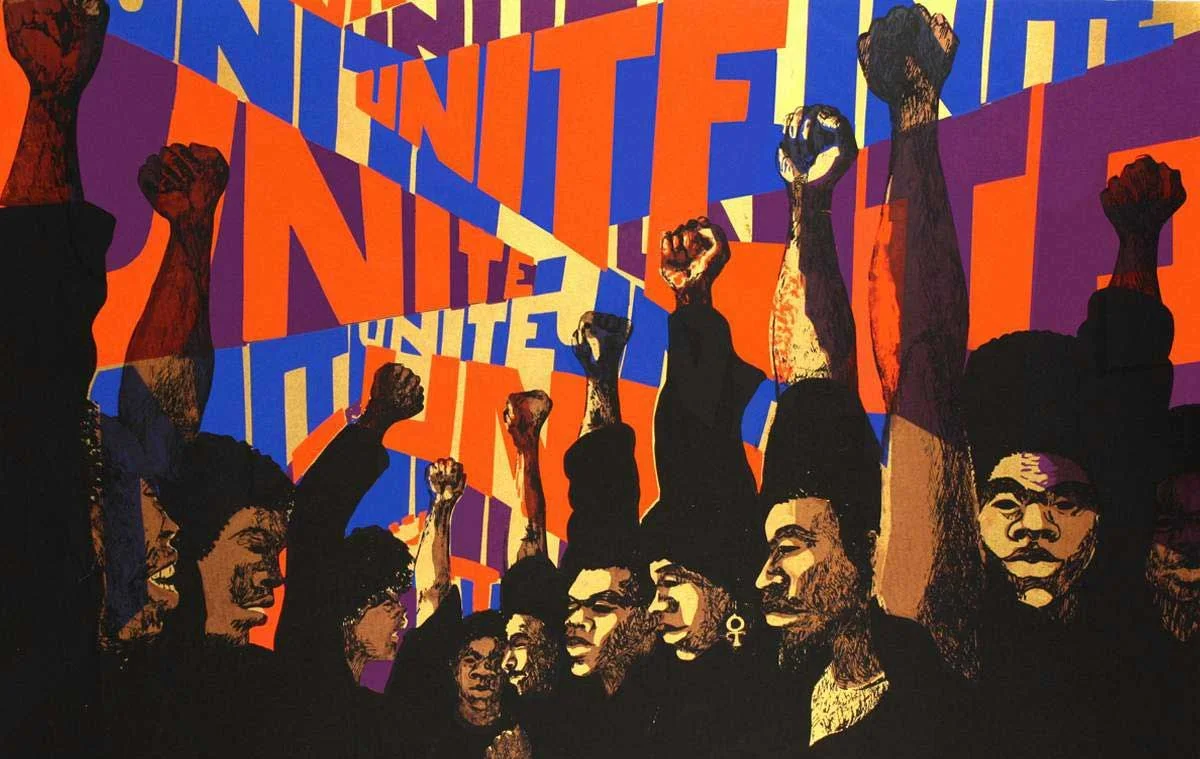
The O’Zone | Country Preacher: Jesse Jackson & Cannonball Adderley

The pulpit and the bell of a saxophone
meeting in the humid air of Chicago,
Where the South migrated to find a new rhythm.
A tall shadow of “I Am Somebody”
his voice percussive, cadence catching the heartbeat of the crowd,
turning the tide into a rally rhythm and rhyme.
He’s not just speaking; he’s soloing,
bending the vowels of justice until the room feels the weight of gospel.
And there is Cannonball,
Holding that alto like a golden lung,
playing “Country Preacher”,
He doesn't need a microphone to testify.
Pouring out his blues in thick, soulful layers—
some joyous earthy shouting
that bridges the gap between the sanctified
and the smoke-filled club.
One uses the Word to wake the world,
the other uses the Breath to heal it.
Two sides of the same soul,
improvising on the theme of freedom,
reminding us that the revolution
has always been a song
waiting for its turn to be played.
“Today on this program, you will hear gospel, and rhythm and blues, and jazz. All those are just labels. We know that music is music.” —Jesse Jackson
The Reverend Jesse Jackson was a towering figure in the American Civil Rights Movement and two-time presidential candidate. He is famously associated with the empowering poem and call-and-response litany
“I am, Somebody," which served as a cornerstone of his message for decades.
When Cannonball Adderley introduced the hit song “Mercy, Mercy, Mercy” live, he would reflect on advice he shared with his band and by extension his audience, about handling hardship, a central theme of Reverend Jackson’s work: “Sometimes we’re not prepared for adversity…I have advice for all of us. It sounds like what you’re supposed to say when you have that kind of problem.”
Adderley often publicly called jazz “a vehicle for social change,” which aligned with Jackson’s view that “art must be uplifting and inspiring”.
Julian “Cannonball” Adderley and the Reverend Jesse Jackson shared a deep bond rooted in the intersection of jazz and the Civil Rights Movement.
Cannonball was a vociferous supporter of Reverend Jackson’s work, particularly Operation Breadbasket, an initiative focused on economic empowerment for Black communities. Adderley’s 1969 live album
"Country Preacher" was recorded at an Operation Breadbasket meeting in Chicago. The title itself is a tribute to Jackson, who was often referred to by that moniker at the time. Joe Zawinul, who as a member of Cannonball’s band wrote “Mercy, Mercy, Mercy,” also coincidentally wrote “The Country Preacher” for Reverend Jackson.
After playing with Cannonball, Zawinul joined Miles Davis. After that, he formed Weather Report with Wayne Shorter and Miroslav Vitous.
Jesse Jackson and Julian “Cannonball” Adderley became close friends over the years. Both men had gregarious, caring personalities and came to admire one another. Jackson held Adderley’s social consciousness in such high regard that he appointed the saxophonist as his national ambassador for the arts and culture. Cannonball frequently performed at Saturday morning rallies in Chicago to help draw crowds and boost morale for Jackson’s economic boycotts. Adderley and Jackson both had deep rooted beliefs that “civil rights translate to civil economics”.
The boycott strategy employed primarily through Operation Breadbasket and later the Rainbow PUSH Coalition, targeted companies that benefited from Black consumers but failed to hire Black workers or support Black-owned businesses. In the late 1960s and early 1980s, Coca-Cola, Pepsi, and 7-Up signed “covenants” to hire more Black workers and use Black-owned banks after facing boycott threats.
Voter registration was another issue both men worked on together. While Adderley was not known for making explicit political speeches about voter registration, he was deeply involved in the Civil Rights movement through his music, personal associations, and financial support. When he did speak out, it was primarily on the bandstand, bantering with his audiences. Adderley actively participated in benefit concerts for Civil Rights organizations. He was featured in advertisements for CORE (the Congress of Racial Equality).
In his ongoing New York Amsterdam News column “Cannonball on the Jazz Scene,” Adderley focused on expanding the “public” for jazz to challenge the industry’s racist practices. While he often let the music speak for his politics, his presence at major Civil Rights rallies signaled his commitment to the era’s legislative goals, including the Voting Rights Act of 1965. Adderley was a vocal advocate for the importance of Black Music as a tool for social change.
In 1967, Cannonball recorded a cover of the Staple Singers’ “Why Am I Treated So Bad,” a song inspired by the Little Rock Nine, the African American students who faced intense hostility while integrating Little Rock Central High School.
He recorded “Minority” early in his career (1958) as a nod to his pride in his identity and his status as a Black artist in a segregated industry.
“Work Song,” written by his younger brother Nat Adderley, is a modern standard inspired by their childhood in Florida, where Nat had childhood memories of Black convict laborers working in chain gangs. It serves as a stark musical commentary on the history of forced labor and racial oppression. The plantation that hosted convict laborers still exists.
Adderley often referred to Jackson as “our pastor” during live sets, explicitly crediting the Reverend with giving the band “guidance” and “understanding” during the turbulent late 1960s. Jackson, in turn, frequently used Adderley’s music as the “soundtrack” to his speeches on racial justice.
The collaboration between Jesse Jackson and Cannonball Adderley was more than a meeting of jazz and justice: it was a rhythmic affirmation of somebodyness. When Adderley’s quintet recorded Country Preacher
At a Chicago church meeting for Operation Breadbasket in 1969, they weren’t just playing a set–they were providing the soundtrack for a movement.
Jackson’s refrain, “I Am, Somebody,” served as the heartbeat for this era, a “holy covering” that reminded a generation that their dignity was non-negotiable and their worth was inherent, regardless of their status or the systems trying to erase them. As Adderley’s soulful saxophone wove through gospel and blues, it echoed Jackson’s sentiment that music is a tool for understanding and community.
Together, they proved that when a preacher speaks identity into a crowd and a musician captures that new thing in melody, the result is a powerful sense of somebodyness that can never be silenced.
Stay connected to KUVO’s programs and our community! Sign up for the Oasis E-News today!